SIRA CCTV Approval & Compliance Guide for Dubai Commercial Businesses (2026 Regulations & AED Cost Guide)
By SecureNet Services Engineering Team • Published Dubai, UAE
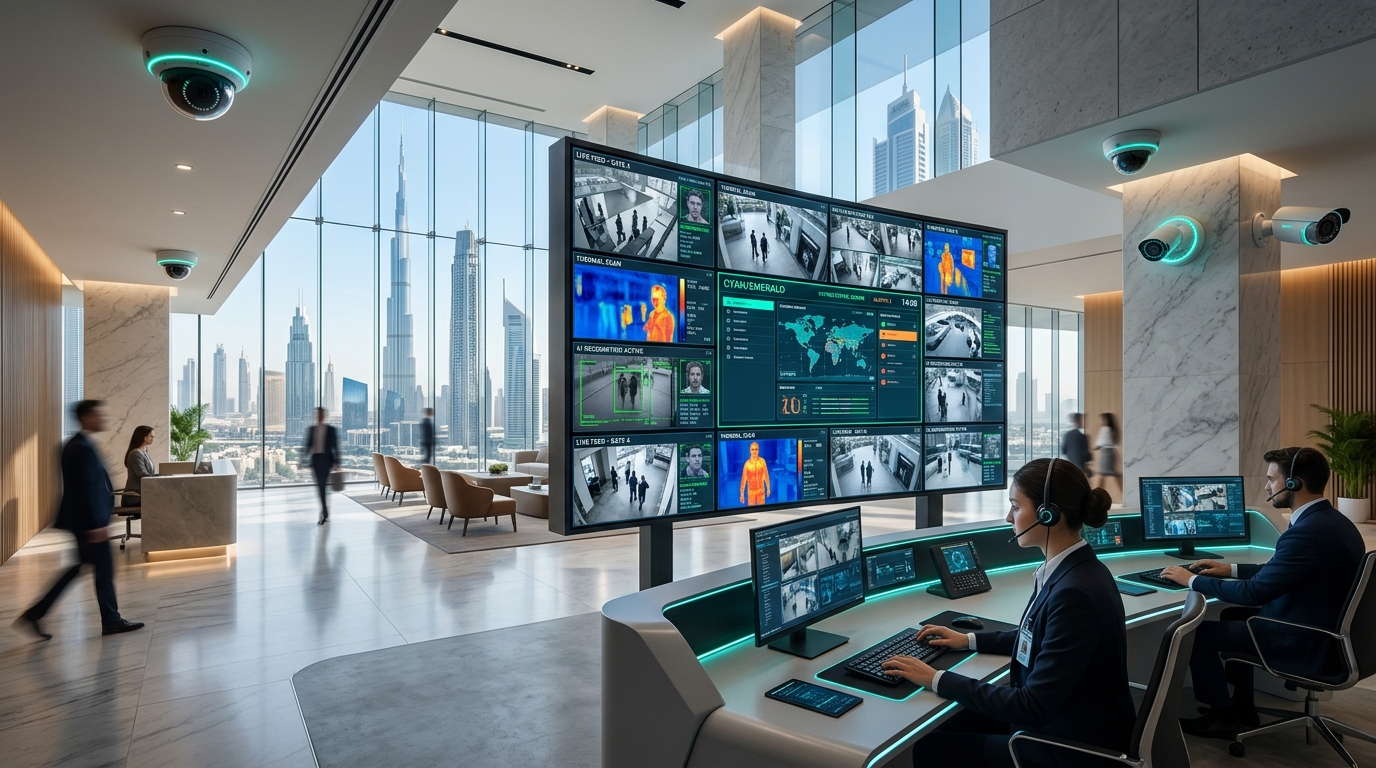
Whether launching a new corporate headquarters in Business Bay, fitting out a retail boutique in Dubai Mall, or managing an industrial logistics facility in JAFZA, securing a SIRA CCTV Approval & Completion Certificate is not an optional security preference—it is a strict statutory requirement mandated by Dubai Police and the Security Industry Regulatory Agency (SIRA) before the Department of Economy and Tourism (DET / DED) will issue or renew your commercial trade license.
Under Dubai Law No. (12) of 2016, commercial facilities must comply with rigorous video surveillance standards covering camera placement, minimum optical resolution, illumination lux ratings, mandatory 31-day recording retention, uninterrupted power supply (UPS) runtimes, and active SIRA Annual Maintenance Contracts (AMC). Cutting corners with uncertified consumer-grade cameras or unapproved installers inevitably leads to failed SIRA audits, costly site re-inspections, delayed tenancy handovers, and substantial financial penalties.
This authoritative 2026 engineering guide provides facility directors, IT managers, and fit-out contractors with the exact technical specifications, approval roadmap, and realistic AED cost benchmarks required to achieve first-time SIRA certification across Dubai.
Essential 2026 SIRA CCTV Compliance Highlights:
- Certified Installer Mandate: Surveillance systems must strictly be engineered, installed, and commissioned by a SIRA-licensed security integrator. DIY or uncertified contractor installations are automatically rejected.
- Mandatory 31-Day Storage: NVR or SAN storage arrays must guarantee 31 continuous days of non-stop recording at minimum 1080p Full HD resolution at 15–25 frames per second (fps).
- Critical Zone Coverage: 100% of perimeter entrances, cash registers (POS counters), emergency exits, reception desks, and server/telecom rooms must have zero blind-spot camera coverage with facial identification capability.
- Continuous Power Backup: Every SIRA surveillance system must be backed by an online double-conversion UPS delivering a minimum of 2 to 4 hours of autonomous recording during power grid failure.
- Compulsory SIRA AMC: DED trade license renewals require an active, attested SIRA Annual Maintenance Contract logged in the official SIRA portal.
Phase 1: Official SIRA Camera Technical Specifications
SIRA categorizes commercial premises based on risk profiles (e.g., General Trading Offices, Jewelry & Gold Outlets, Money Exchanges, Warehouses, Hotels, and Shopping Malls). While high-risk venues face enhanced biometric and Video Guard requirements, all commercial premises must meet these foundational hardware benchmarks:
| Surveillance Component | SIRA Minimum Standard | Recommended Enterprise Spec | Key Purpose |
|---|---|---|---|
| Camera Resolution | Full HD 1080p (2.0 Megapixels) | 4MP to 8MP (4K UHD) | Facial identification at entrances; bill note reading at POS counters |
| Recording Frame Rate | Minimum 15 to 25 FPS | 25 FPS (Real-Time PAL) | Eliminates motion blur during fast subject movement |
| Video Compression | H.264 High Profile | H.265+ Smart Codec | Reduces hard drive storage requirements by up to 50% without quality loss |
| Storage Duration | Strictly 31 Days Continuous | 35–45 Days Safety Buffer | Ensures historical forensic evidence availability for police investigation |
| Night Vision (IR) | Smart IR up to 30 Meters | ColorVu / DarkFighter 0.0005 Lux | Full-color nighttime surveillance even in pitch-black warehouse interiors |
| Physical Protection | IP66 Weatherproof / IK10 Vandal-Proof | IP67 Weatherproof / IK10 Rated | Resists desert sandstorms, 50°C summer heat, and mechanical impact |
Phase 2: Critical Camera Placement & Layout Rules
During the on-site inspection, SIRA auditors evaluate camera placement against precise optical criteria: Detection, Observation, Recognition, and Identification (DORI standards).
Main Entrances & Lobby Portals
Identification Requirement: Every person entering the premises must have their face captured clearly at eye level (camera mounted between 1.6m and 1.8m height, or high-angle camera with narrow varifocal optical zoom).
- Wide Dynamic Range (True WDR ≥ 120dB) is strictly required to counter bright Dubai sunlight backlighting glass doors.
- Face width must occupy at least 250 pixels per meter (PPM) at the entry threshold.
Cash Counters & POS Transaction Points
Transaction Verification: Every point of cash or credit card exchange requires a dedicated narrow-angle camera focused on the till.
- Must clearly display currency note denominations, credit card receipts, and customer hands.
- Often paired with high-definition audio recording where permitted by local privacy laws.
Server Rooms, Telecom Closets & NVR Vaults
Access Protection: SIRA strictly mandates that the NVR and server rack must be protected inside a secure, access-controlled room.
- A dedicated camera must view anyone approaching or opening the equipment enclosure.
- NVRs must be locked inside a tamper-resistant metal server rack with physical key locks.
Emergency Exits & Perimeter Loading Docks
Life-Safety & Egress: Fire exit stairwells and warehouse roller shutter docks require continuous monitored recording.
- Captures unauthorized rear entry or emergency egress during building evacuations.
- Weatherproof IP67 bullet cameras with extended infrared illuminate dark alleyways.
Phase 3: The 5-Step SIRA Approval Roadmap for Dubai Businesses
Securing your official SIRA Certificate follows a standardized 5-step government milestone process:
-
Step 1: Security Design & CAD Drawing Submission:
Your SIRA-approved security contractor prepares architectural AutoCAD floor plans illustrating camera positions, fields of view (FOV), blind spots, storage calculations, and network cable routing for initial SIRA engineering review.
-
Step 2: Installation by Licensed SIRA Engineers:
Cabling must utilize fire-rated Low Smoke Zero Halogen (LSZH) Cat6 copper conduits. Cameras and NVRs are installed strictly adhering to the approved CAD schematics, including dedicated UPS power and patch panel labeling.
-
Step 3: SIRA Portal Registration & Video Guard Connection (If Applicable):
The contractor registers the client's Trade License, company details, camera serial numbers, and MAC addresses in the official SIRA digital portal. High-risk premises are linked to SIRA's centralized Video Guard monitoring center.
-
Step 4: Official SIRA On-Site Inspection:
A certified SIRA Police Inspector visits the facility to test 31-day video storage playback, verify UPS runtime during simulated power cuts, check field-of-view clarity, and confirm equipment room physical security.
-
Step 5: SIRA Completion Certificate Issuance:
Upon passing the audit, SIRA issues the electronic SIRA Security Completion Certificate, which automatically unlocks DED trade license issuance or renewal without delays.
Phase 4: SIRA Annual Maintenance Contract (AMC) Rules
In Dubai, your regulatory responsibility does not end with system installation. SIRA mandates that every commercial CCTV installation maintain an active, valid SIRA Annual Maintenance Contract (AMC) signed with a licensed security company.
What Does a SIRA AMC Require?
Under SIRA regulations, an accredited security provider must perform:
- Quarterly Preventive Inspections: 4 scheduled visits per year to clean camera lenses, check focus, verify 31-day HDD health, test UPS batteries, and update firmware.
- 24/7 Breakdown Response: Mandatory emergency call-out dispatch within 4 hours if camera recording fails.
- SIRA Portal Logging: Maintenance service reports must be uploaded to the SIRA system to prevent DED commercial license blocks upon annual renewal.
Phase 5: UAE Cost Breakdown & SIRA Package Pricing (AED)
To help business owners, procurement managers, and interior contractors budget transparently, here is the verified 2026 Dubai pricing benchmark for turnkey SIRA-compliant CCTV packages:
| Commercial Package | Hardware & Storage Scope | Included Approvals | Estimated Investment (AED) |
|---|---|---|---|
| Small Retail Boutique / Clinic (4-Camera SIRA Kit) | 4x 4MP IP Dome Cameras + 8-Channel NVR + 8TB Surveillance HDD (31 Days) + Online UPS | SIRA Drawing, Testing & Inspection Assistance | AED 4,800 – AED 6,800 |
| Medium Office / Restaurant (8-Camera SIRA Kit) | 8x 4MP/5MP WDR Cameras + 16-Ch NVR + 16TB HDD (31 Days) + 1.5kVA Online UPS + Rack | SIRA Portal Filing, Drawings & 1-Year SIRA AMC | AED 8,500 – AED 12,500 |
| Commercial Warehouse / Logistics (16-Camera SIRA Kit) | 16x 4MP/8MP IP Cameras (Dome + Bullet) + 32-Ch NVR + 32TB HDD + 2kVA UPS + Server Rack | Full Turnkey SIRA Certification & 1-Year Attested AMC | AED 15,500 – AED 22,000 |
| Multi-Tenant Tower / Facility (32+ Camera Enterprise) | 32+ 4K IP Cameras + SAN/NAS Enterprise Storage + Dual Redundant UPS + Client Video Wall | Video Guard Integration + SIRA Police NOC | AED 32,000 – AED 55,000+ |
| Annual SIRA Maintenance Contract (AMC Only) | 4x Quarterly Preventive Maintenance Visits + Emergency Support + Portal Certificate | Attested SIRA AMC for DED Renewal | AED 1,200 – AED 2,800 / year |
Frequently Asked Questions (FAQ)
Can an uncertified interior fit-out contractor install SIRA CCTV cameras?
No. While general contractors can lay empty PVC conduit pipes, all active security cabling, camera mounting, NVR commissioning, and testing must be executed by a security company holding an active SIRA license. SIRA inspectors will not accept applications or issue certificates from unauthorized companies.
What happens if our CCTV hard drive storage drops below 31 days during an inspection?
If a SIRA inspector requests playback from exactly 31 days prior and the footage is missing due to undersized hard drives or incorrect bitrate calculation, the inspection is immediately marked as FAILED. The business will be issued a re-inspection notice and must purchase additional certified surveillance hard drives before re-applying.
Is SIRA certification required in Abu Dhabi and Sharjah as well?
SIRA jurisdiction covers the Emirate of Dubai. In Abu Dhabi, commercial surveillance is regulated by the Monitoring and Control Centre (MCC / ADMCC). In Sharjah, surveillance systems must comply with Sharjah Police requirements. While the regulatory bodies differ, technical standards (Full HD cameras, 31-day storage, UPS backup, and certified installers) remain almost identical across all UAE emirates.
Need Guaranteed SIRA Approval for Your Dubai Business?
SecureNet Services delivers turnkey SIRA-compliant CCTV systems, CAD security drawings, 31-day storage provisioning, attested SIRA AMC contracts, and guaranteed first-time inspection approval across Dubai.