Structured Cabling Checklist for New Dubai Office Fit-Outs (2026 Engineering Guide)
By SecureNet Services Engineering Team • Published Dubai, UAE
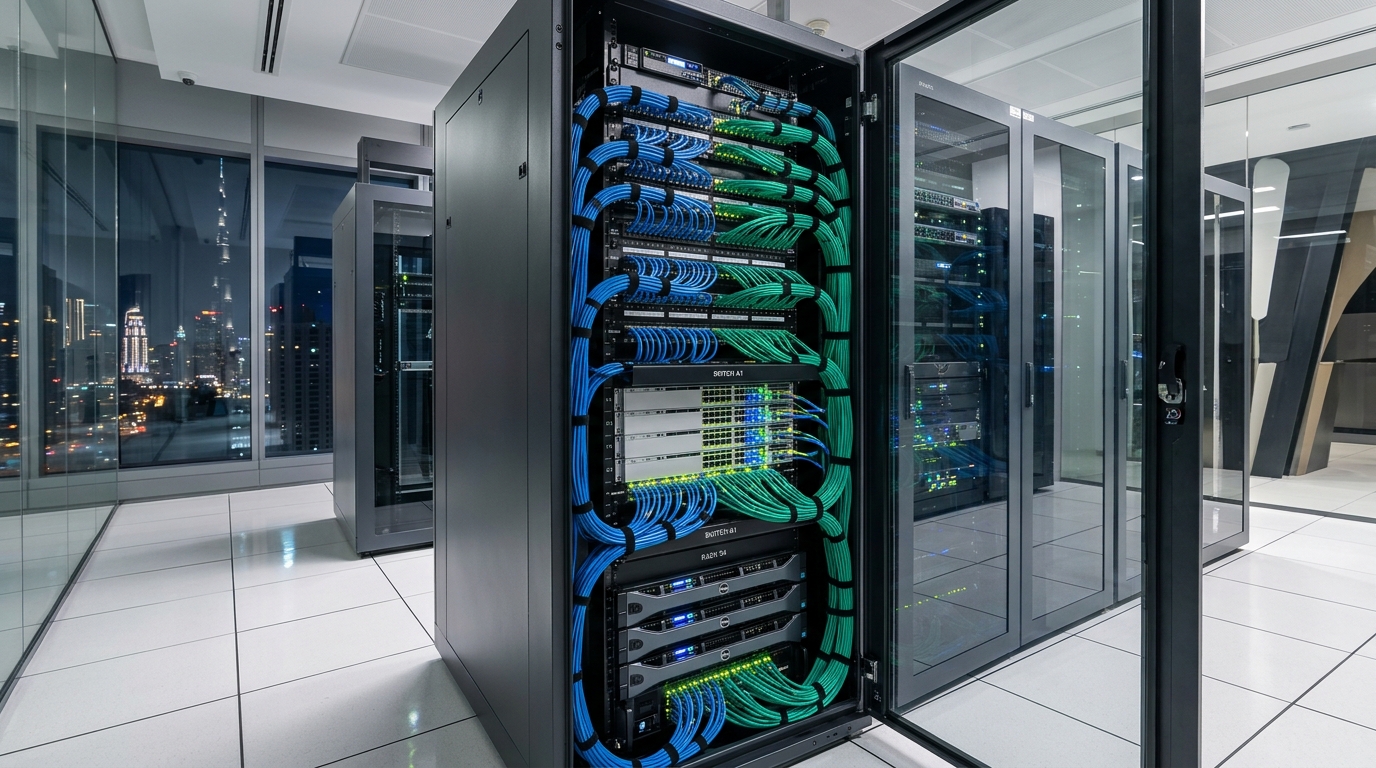
Planning a commercial office fit-out in Dubai—whether in DIFC, Business Bay, Downtown, DMCC JLT, or Dubai Internet City—involves dozens of moving parts. Yet, among MEP permits, glass partitions, and ergonomic furniture, no single infrastructure component dictates your company's day-to-day productivity more fundamentally than structured network cabling.
A beautifully designed workplace can be crippled on day one if Wi-Fi 7 access points suffer latency, IP phones drop calls during client presentations, or server room patch panels resemble a tangled bird's nest. Furthermore, Dubai building management authorities (TECOM, Emaar, DMCC, DCCA) enforce stringent MEP regulations, including Low Smoke Zero Halogen (LSZH) fire-safety jacket mandates and mandatory Fluke DSX certification before issuing fit-out handover approvals.
This comprehensive 2026 engineering checklist outlines everything IT directors, project managers, and interior contractors need to execute a flawless, future-proof network infrastructure across the UAE.
Key Engineering Takeaways for Dubai Fit-Outs:
- Mandatory LSZH Cables: UAE Civil Defense strictly prohibits PVC-jacketed data cabling inside commercial ceilings; only LSZH (IEC 60332-1) rated cables are permitted.
- Cat6 vs. Cat6A: Standard Cat6 caps 10Gbps transmission at 35–55 meters; Cat6A guarantees 10Gbps at full 100-meter channel lengths with zero alien crosstalk.
- Average Dubai Pricing: Certified data drops typically range from AED 135 to AED 220 per point, inclusive of cable, faceplate, patch panel termination, and Fluke certification.
- Carrier Interconnect: Always reserve dedicated 4-core single-mode fiber links between your server rack and the building Main Telecom Room (MTR) for du or e& (Etisalat) enterprise leased lines.
Phase 1: Planning, Capacity Sizing & Cable Category Selection
Before a single conduit is pulled through floor slabs or ceiling grids, you must calculate total port density and determine whether Cat6 UTP or Cat6A F/UTP (Shielded) aligns with your bandwidth lifecycle.
1. The Rule-of-Thumb Drop Density Formula
Underestimating network points is the costliest fit-out mistake. Once gypsum walls are painted and acoustic ceiling tiles are locked in place, adding retrospective cable drops costs 300% more in labor and disruption. Use this proven commercial allocation formula:
- Standard Workstation Desks: 2 data drops per desk (1 for VoIP IP Desk Phone with PoE passthrough, 1 for PC / Docking Station).
- Executive & Finance Cabins: 4 data drops (2 for desk/laptop, 1 for dedicated network printer, 1 spare for secure terminal).
- Meeting & Boardrooms: 4 to 6 data drops (1 for Zoom/Teams Video Conferencing Bar, 1 for Table Presentation Pod, 1 for Interactive Touch Display, 2 for under-table guest LAN).
- Ceiling Wi-Fi Access Points: 2 data drops per AP location (primary PoE+ data + 1 redundant link supporting future multi-gigabit Wi-Fi 7 aggregation).
- Biometrics, CCTV & Access Control: 1 dedicated Cat6 drop per door controller (e.g., ZKTeco Horus E1-FP, Bioface terminals, or speed gates) routed directly to the security VLAN switch.
2. Cat6 vs. Cat6A: Which Standard Should You Deploy in 2026?
| Technical Parameter | Category 6 (Cat6) | Category 6A (Cat6A) | UAE Recommendation |
|---|---|---|---|
| Max Bandwidth Frequency | 250 MHz | 500 MHz | Cat6A has 2x higher frequency |
| 10 Gbps Ethernet Distance | Up to 35–55 meters only | Full 100 meters (328 ft) | Critical for larger office floorplates |
| Alien Crosstalk (ANEXT) | Vulnerable in tight cable bundles | Superior foil shielding (F/UTP) | Essential near LED drivers & HVAC units |
| PoE Support (Power over Ethernet) | PoE (15.4W) & PoE+ (30W) | PoE++ (Type 4, up to 90W) | Required for smart displays & PTZ cameras |
| Cable Jacket Fire Rating | LSZH (Low Smoke Zero Halogen) | LSZH (Low Smoke Zero Halogen) | Mandatory by UAE Civil Defense |
| Average Installed Cost per Point | AED 135 – AED 165 | AED 175 – AED 220 | Cat6A is 15-20% higher, but lasts 10+ years |
Verdict for Dubai: If your office lease is 3 years or longer, specify Cat6A F/UTP for high-density backbone drops, ceiling APs, and server room links. Cat6 UTP remains acceptable for standard low-bandwidth user desktop ports on compact office floorplates under 2,000 sq ft.
Phase 2: Server Room & Rack Sizing Architecture
A server enclosure is not merely a steel storage box; it is the thermal, electrical, and physical security core of your enterprise network. Choosing the wrong rack height or depth creates severe airflow constriction and maintenance nightmares.
1. Selecting the Correct Rack Height (U-Rating)
- 12U to 18U Wall-Mounted Cabinets: Best for satellite branches, medical clinics, and retail outlets with under 40 network drops. Must have minimum 600mm depth to house 24-port PoE switches and patch panels.
- 24U Free-Standing Enclosures: Ideal for mid-sized Dubai offices (2,000 to 5,000 sq ft) with 50 to 120 network drops. Depth must be minimum 800mm to accommodate an online rackmount UPS and router.
- 42U Enterprise Floor Enclosures (800mm W x 1000mm D): Mandatory for corporate headquarters, financial firms in DIFC, and technology companies running on-premise rack servers (Dell PowerEdge / HPE ProLiant), NVR storage systems, and firewall high-availability clusters.
2. Rack Layout Best Practices (Top-to-Bottom Distribution)
To maximize heat dissipation and avoid cable congestion, follow this industry-standard layout:
- Top 2U: Fiber Optic Patch Panel (LIU) interconnecting telecom service providers (du / e&).
- Upper Middle: Cat6/Cat6A RJ45 Keystone Patch Panels alternating with 1U horizontal cable managers.
- Middle: Core and PoE+ Distribution Switches (Cisco Catalyst, Aruba CX, or UniFi Pro PoE).
- Lower Middle: Next-Gen Firewalls (Fortinet FortiGate, Sophos XGS) and Grandstream IP PBX appliance.
- Bottom 4U: Online Double-Conversion Rackmount UPS (APC Smart-UPS 3000VA or Eaton) to keep the heaviest weight at the base for seismic stability.
Phase 3: Pathway Containment, Conduit Separation & DEWA Safety
One of the most frequent causes of failed landlord inspections in Dubai commercial buildings is improper containment routing. High-voltage 220V/380V electrical conduits produce powerful electromagnetic fields (EMI) that induce noise and packet corruption in unshielded data cables.
DEWA & BICSI Clearance Standards:
Always maintain a minimum separation of 200mm (8 inches) between data cable containment trays and 230V AC power cables. When data lines must cross high-voltage power conduits, they must strictly cross at a 90-degree right angle to eliminate parallel electromagnetic coupling.
Checklist for Pathways & Containment:
- Metal Trunking vs PVC Conduit: Galvanized iron (GI) containment trays with factory-fitted divider channels should be used for under-floor raised access tile distribution.
- Ceiling Suspension: Data cables in ceiling plenums must rest on dedicated wire mesh cable basket trays or J-hooks every 1.2 to 1.5 meters. Never allow cables to lay directly across acoustic ceiling grid metal tees or flexible AC ducts.
- Bend Radius Integrity: Maintain a minimum bend radius of 4x the outer cable diameter for Cat6 (approx. 25mm) and 8x for Cat6A (approx. 50mm). Kinking or cinching cables with rigid plastic zip ties damages internal pair twists; always use reusable hook-and-loop velcro ties.
Phase 4: Fluke Certification & Building Handover Documentation
A simple continuity tester with blinking green lights only verifies that pin 1 connects to pin 1. It tells you nothing about high-frequency attenuation, Near-End Crosstalk (NEXT), or return loss at gigabit speeds.
Professional fit-out handovers in the UAE require full Fluke DSX-8000 CableAnalyzer Channel or Permanent Link certification. Every single RJ45 port must be tested, and a comprehensive PDF test report containing the graphical frequency sweep must be submitted to the client and building facilities manager.
What Fluke Tests Verify:
- Wire Map: Identifies split pairs, shorts, and miswires.
- Propagation Delay & Skew: Critical for multi-gigabit switches.
- NEXT & PS-NEXT: Ensures neighboring pairs do not leak signal.
- Return Loss: Detects impedance mismatches from poor terminations.
Required Handover Dossier:
- As-Built CAD drawings marking exact drop coordinates & port numbers.
- Fluke Networks LinkWare PDF test summary for 100% of drops.
- Comprehensive patch panel labeling schematic.
- Manufacturer 25-Year System Warranty certificate (Schneider, Panduit, CommScope).
Phase 5: Commercial Budgeting & UAE Cost Breakdown (AED)
To help you budget accurately for your Dubai commercial fit-out, here is an average cost benchmark breakdown for 2026 enterprise installations:
| Infrastructure Item | Scope & Specification | Estimated Rate (AED) |
|---|---|---|
| Cat6 UTP Data Drop (Complete) | Cable, dual faceplate, patch panel termination, labeling & Fluke test | AED 135 – AED 165 / point |
| Cat6A F/UTP Shielded Drop (Complete) | 10Gbps shielded cable, die-cast keystone, grounding & Fluke certification | AED 175 – AED 220 / point |
| 24U Server Rack (Free-Standing) | 800x1000mm, perforated front/rear doors, fan tray, vertical cable managers | AED 1,800 – AED 2,800 |
| 42U Enterprise Server Rack | 800x1000mm heavy-duty enclosure with dual PDU strips & digital temperature display | AED 3,200 – AED 4,800 |
| Fiber Backbone Interconnect (MTR to Rack) | 4-core or 8-core Single-Mode OS2 fiber link with fusion splicing & OTDR test | AED 1,600 – AED 2,500 |
| Online Rackmount UPS (3000VA) | Double-conversion pure sine wave with SNMP remote network monitoring card | AED 4,500 – AED 7,200 |
Frequently Asked Questions (FAQ)
Does Dubai Civil Defense require LSZH cable jackets for all office fit-outs?
Yes. In all commercial office towers across Dubai and Abu Dhabi, building management authority guidelines strictly mandate Low Smoke Zero Halogen (LSZH) jacketed copper and fiber cables. In the event of a fire, LSZH cables do not emit toxic halogen gases or dense black smoke, ensuring emergency escape stairwells and corridors remain breathable.
How far can Cat6A cabling run in an office before requiring a repeater switch?
Under international TIA/EIA-568 standards, the maximum permanent link distance for Cat6A is 90 meters (295 ft), with an additional 10 meters allocated for patch cords (5m at the server rack and 5m at the work area), totaling a 100-meter channel length. If your floorplate exceeds this distance, you must deploy an intermediate distribution frame (IDF) or run an optical fiber backbone.
What is the difference between Channel testing and Permanent Link testing on a Fluke?
Permanent Link testing tests the installed horizontal cable running from the patch panel to the wall faceplate RJ45 keystone jack. This is the industry-standard test required for landlord handover and manufacturer warranty. Channel testing includes the user patch cords at both ends, which can mask or add external patch cord defects.
Planning a Commercial Office Fit-Out in Dubai?
SecureNet Services delivers turnkey structured cabling, Fluke DSX-8000 certified reports, server rack builds, and SIRA-compliant security across Dubai, Abu Dhabi, and Sharjah.